Monday, April 30, 2007

Weekly Update: Critters Attack Garden (71 GDD)

4/22 - Critters began digging up seeds, eating lettuce and chard.
4/28 - First tulip blooms; bibb lettuce transplanted; solitary spinach test-seedling planted; soil temp = 52
4/29 - First pea and beet sprouts emerge.

Saturday, April 28, 2007

Boston in Bloom #2


Commonwealth Avenue, originally uploaded by tpl108.

Thursday, April 26, 2007

Dividing Hostas

Hastily planted early last fall, this hosta (pictured is 1/4 of the original plant) was dug up and divided into quarters to fill out a newly created garden bed behind the garage that receives only a very few hours of direct sunlight.

Dividing hostas is very easy and seemingly hard to mess up. Spring appears to be the best time, although I've read that it'll handle division just about anytime of the year, maybe with the exception of winter. Dig up a clump and cut it in half or quarters with a spade so that the final clump has five or six shoots. Return them to the soil and before long they'll root and spread their leafy wings once again.

Hostas' tolerance for neglect, unlike baby chicks, is astounding. While walking through a somewhat wooded section of yard, I came across an old hosta that had been tossed in the woods last fall. Despite sitting out all winter on top of a pile of leaves, the plant was actually sending up shoots. It's since been planted in a far corner of the yard and we'll see how it does.

Sources: Bob's Hostas, HGTV, Royal Hort. Soc'y, Ohio State

Tuesday, April 24, 2007

Boston in Bloom


Commonwealth Avenue, originally uploaded by tpl108.

This makes New England winters bearable.

Monday, April 23, 2007

rhododendron mucronulatem "cornell pink"

A deciduous azalea-like rhododendron, it's incredibly hardy, tolerates full-sun to light shade, and puts out rich pink blossoms in the spring and has rusty colored leaves in the fall. This plant anchors the right bank of a newly planted bed behind the garage, which had previously been a dazzling collection of the great weeds and noxious plants of North America.


Sources: U of Minnesota, U Mass., U. Conn

Weekly Update; Hot Weather Signals End of 49-Days of March (GDD 37)


Daffodills, originally uploaded by tpl108.

April 15-19 -- Cold and rainy
April 19 -- Nor'easter finally departs. Soil temp = 44 F.
April 20 -- First peony shoot emerges
April 21 -- Daffodils bloom; vegetable garden started; lawn fertilized and patched; soil temp = 58 F
April 22 -- Forsythia flowers open

Saturday, April 21, 2007

With Much Fanfare, the Vegetable Garden is Started

After weeks of abnormal cold weather, abundant sunshine and summer-like heat warmed the vegetable bed considerably in just a few days, raising the temperature t0 57 degrees at a depth of six inches. With temperatures rising, it was time to get some cooler crop vegetables in the ground.

Sown: 4' of peas, 4' of pole beans, and beets
Transplanted: romaine, red sails lettuce, "Bright Lights" swiss chard. (the UBC Botanical Garden has an amazing photo of Bright Lights.)

Thursday, April 19, 2007

Filling Raised Garden Bed with Dirt

An 8'x4'x1' bed holds (get ready for some serious math) 32 cubic feet of soil, laundry, or stray cats. That's enough dirt to seriously strain the shocks of an aging station wagon, but not quite enough to make it worth renting a truck and visiting the dirtmonger. Perched high atop the horns of a dilemma, the problem was resolved when a recent price war between Lowes and Home Depot ushered in sale prices on Miracle Grow Garden Soil, 2 cubic feet for about 6 and half dollars. At that price, it made sense to buy about 14 bags of soil and 200 pounds of composted cow manure, which, surprisingly, isn't exactly dirt cheap. Along with a hefty amount of sphagnum peat moss, it took 12 bags of soil and 160 pounds of composted cow manure to fill the bed within an inch of the top.

Positioned on the margin of a fairly wooded section of yard, the bed was lined with some landscape fabric. It's hoped this will keep weeds and roots from growing into the bed -- at least for a little while.


Sunday, April 15, 2007

Weekly Update; Cold Weather Continues (GDD 25)

Cloudy, cold, and rainy typified the past week. Buds on a few deciduous trees began to swell noticeably. Some even showed a bit of color. Springtime bulbs like tulips and daffodils continued to march toward bloom, which is probably two or three weeks off still. Pictured at left are garlic chives. These were planted three years ago and seem to be finally hitting its stride.

April 9 As yet unidentified tree in backyard sets red flower-like buds.
April 12 First bud on hydrangea emerges; wild turkey struts across backyard; rain and sleet
April 14 Raised garden bed filled; forsythia just starting to turn yellow
April 15 Late season nor'easter drops 3+ inches of rain; no growing degree days logged for April thus far

Tuesday, April 10, 2007

Winter Damage Seen on Meserve Holly and Rhododenrons

Despite a warm start, the winter of 2007 was particularly hard on the broadleaf evergreens on the grange. The rhododendrons and the female meserve holly have large swaths of dead, brown, and dessicated leaves.

To quote the experts,

"Winter burn is caused from desiccation, which is a type of dehydration injury. When roots are in dry or frozen soil, water lost through transpiration cannot be replenished by the roots and dehydration occurs. Water loss through transpiration is normally low during winter months, but it increases when plants are subjected to drying winds or are growing in warm sunny spots."

Source: High Plains Journal, "Winter Damage to Broadleaf Evergreens" available here.

Moreover, chlorophyll is destroyed at temps below 28 F, leading to further damage. Fear not, however, for winter, like ladybugs and pretty pink flowers, is a fact of nature.

According to the University of Minnesota,

"If an evergreen has suffered winter injury, wait until mid-spring before pruning out injured foliage. Brown foliage is most likely dead and will not green up, but the buds, which are more cold hardy than foliage, will often grow and fill in areas where brown foliage was removed. If the buds have not survived, prune dead branches back to living tissue. Fertilize injured plants in early spring and water them well throughout the season. Provide appropriate protection the following winter."

Source: University of Minnesota, Protecting Trees and Shrubs Against Winter Damage, available here.

Monday, April 09, 2007

Weekly Update; Cold Continues (GDD 25)


April 4 - Quick dusting of snow along with temperatures well below normal make gardening all but impossible.
April 7 - Cold temperatures continue.

According to the National Weather Service, temperatures for the first week of April were 10 degrees colder than they were for the first week of January. Return your hybrids now, we need a little thicker blanket around the planet.

pictured: sedum

Sunday, April 01, 2007

Weekly Update (GDD 25)


Crocuses, originally uploaded by tpl108.

March 25 - Quick inch of snow that melted by noon.
March 26 - Daffodils well underway, but no blooms yet.
March 27 - Crocuses in full swing throughout front yard.
March 31 - Bed behind garage cleared out, a few shrubs and trees cleared, chopped up and brought to recycling center.

Raised Garden Bed Completed

Last weekend, the weather was finally nice enough to complete the raised garden bed. With a little input from "The Compost Bin," who advised that my structure didn't need extra bracing, the whole thing went together in about 45 minutes.

The final product deviated from the original plan slightly in that the trellis is positioned on the inside of the bed rather than the outside. All of the lumber came in 8 foot lengths. Securing the trellis to the outside of the frame would have required two sections of 2x4s, which would have been a pain. Unsure of just how visually appealing the trellis would be, it's been secured using galvanized lag bolts that can be unfastened.

All in all, she holds 32 cubic feet of dirt. Priced out by the bag, that'd be about $112 - $120. (Incidentally, there are 52, 40 pound bags of dirt in a cubic yard.) Luckily, there's a pretty swell dirt yard near me that sells a cubic yard of screened loam/compost mix for $30 picked up. Tack on a $20 U-Haul pickup rental, and that's not too shabby. Unfortunately, my desire to garden is not matched by my dirtmonger's ability to supply dirt. Given that it snowed just last weekend and a touch of snow in the in offing this week, much of the dirt is still frozen.

Source: http://www.therockpile.com/pages/order_soil.htm

Monday, March 26, 2007

Bi-Weekly Update

March 13 - Tulips peak through soil; second round of looseleaf and romaine lettuce as well as spinach started; soil temperature at 6 inches - frozen; soil temperature at 2 inches 39 (GDD 12)
March 14 - Record warmth with a high of 70.5. (GDD 6, 18)
March 16-17 - Snowstorm drops nearly 9 inches of snow. (GDD 18)
March 21 - Crocuses bloom
March 24 -
Raised garden bed built

Tuesday, March 13, 2007

Weekly Update (GDD 12)


The Thaw, originally uploaded by D L Ennis.

March 5 spinach seedlings sprout 6 days after sowing (GDD 12)
March 6 cold snap begins as temperatures drop to the single digits (GDD 12)

Monday, March 05, 2007

Weekly Update (GDD 12)


Chives, originally uploaded by chefranden.

Highlights from the past week
March 1 Chives left outside all winter begin sending up shoots despite partial covering of ice. (GDD 12)
March 3 Romaine and looseleaf lettuce sprout 4 days after sowing (GDD 12)

Friday, March 02, 2007

NOAA NOW Data Explored: First & Last Dates


Frost-5, originally uploaded by mike costolo.

An acronym within an acronym (NOAA Online Weather), the National Weather Services' NOW Data offers incredibly useful information. For example, it logs "first/last" dates, such as the first frost, the first 28 degree day, the first time the temperature didn't get above 32, the first 90 degree day, and so on, as well as the last date counterparts. Even cooler is that it notes how many days lapsed between the two dates.

This information can be used to figure out the length of a growing season. For instance, in 2006 the last 32 degree night on the Grange was on April 30 while the first was on October 14, a span of 166 days.

Tuesday, February 27, 2007

Lettuce and Spinach Seeds Mark Start of 2007 Season


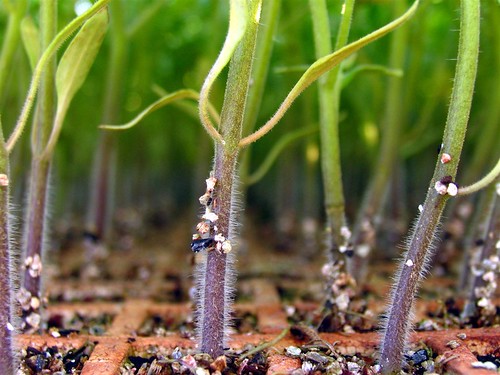
Tomato Seedlings Forest, originally uploaded by joaobambu.

Officially kicking off the 2007 season, lettuce (romaine and loose leaf) and spinach seeds were started tonight. 27 plants in all got the call up. A modest start, given how early it is and the depth of snow on the ground, these seeds should sprout within a few days.

While it might be a bit early, my 28-year-old copy of the Victory Garden suggests otherwise, recommending that I start taking steps before the close of February. Big up, Mr. Crockett. I poured some rudbeckia seed on the ground in honor of you, kind sir.

Some tips for how to start seeds
1. Use a heating pad or a seed starting mat to ensure your seedlings get sufficient heat.
2. Get seed starting mix or equivalent, but don't use regular soil as it might contain pathogens that will kill your seedlings.
3. Make sure your new plants get plenty of light. Think: a really sunny window or two fluorescent lights suspended just inches above your plants and switched on for 18 hours a day.
4. Keep the the soil moist. A no-brainer, but be sure to check on them from time to time and keep a lid on your starting tray during germination.

Source: University of Missouri Extension

Tuesday, February 20, 2007

Growing Degree Days


sundance, originally uploaded by nice+smooth ultramedia.

How fast plants develop is largely dependent on the weather. Cold weather means slower growth whereas warmer weather brings faster growth. Flowers don't bloom because it's April. Plants bloom because April (as well as March, February, and January) have brought warmer temperatures. While calendars are a great way to keep track of plant development, a better way might be to track just how much warmth a plant has received.

This can be done by logging growing degree days ("GDD"). A GDD is a simple calculation. In essence, it's a running tally of the number of degrees above a base point. Although there are many ways of calculating GDD, the easiest way is to take the average daily temperature (high + low / 2) and subtract a base temperate. 50 F is a good base point. Below that, most plants don't grow so well. So, for example, if today's high were 70 and the low was 40, we'd have 5 growing degree days.

Great. So what's that mean? From this events like bloom and pest emergence can be predicted. Plants develop at somewhat specific times. For example, corn is ready at about 1360 GDD. Red maples begin to bloom at 75 GDD. Forsythias get going at about 86 GDD.

From Weather Underground to your local extension agency, GDD data is plentiful. The NWS NOW Data has sensors all over faithfully logging GDD. In fact, there's one not more than a mile away from the grange, which should make it easy to log events based on GDD. While there are plenty of resources for commercial growers, there appear to be few geared toward gardeners. For example, a tomato might take 70 days to bear ripe fruit, but, how will colder or warmer weather affect fruit set and maturation? As such, I'll try to log events and key them to GDDs.

Sources
National Weather Service, National Corn Growing Degree Day Tally
Mont. St. Univ., Using Growing Degree Days to Predict Plant Stages
Ohio. St. Univ. Ext., Biological Calendars (fantastic power point)
Ohio. St. Univ. Ext., Summary of Phenological Events
National Phenological Network
Ohio. St. Univ. Ext. Growing Degree Days as a Method of Rating the Maturity of Corn Hybrids
Weather Underground, Degree Days
NYS GDD Tracker
UMass GDD Checklist (providing information about the timing of blooming and pest emergence based on GDD)

Saturday, February 10, 2007

Fooling Nature: Forcing Forsythia

Plants bloom in the spring as the weather warms up. For the most part, plants aren't as smart as my readers. They can be tricked into blooming months ahead of time. Suckers. A whole bunch of plants, from forsythia to fothergilla, can be forced to bloom. Forsythia is a good candidate. Cuttings can be taken relatively early and they are quick to bloom when brought inside.

"Mimic springtime and your branch will bloom"
Although forcing blooms requires little more than warm temperatures and water, the plants must be out of their dormancy phase. Forsythia's usually ready by mid-January.

On a relatively warm day when the branches aren't frozen solid, take a bunch of cuttings and bring them inside. Mash up the ends with a hammer or your forehead. This will help them suck up lots of water, which, it seems helps them bloom. Next, stick them in a warm place and stare. Within a week or two, you'll have flowers.

top row l to r: 1/25, 2/3; bottom row l to r: 2/8, 2/10

Sources: "Garden Geek," Iowa State Extension Service, About.com