Early Morning
Hunnewell Forest
Natick, MA
These mushrooms, which I think are Lycoperdon pyriforme, were on the side of steeply sloped bank under a canopy of oak trees located in the Hunnewell Town Forest in Natick, Massachusetts. There were a few large clumps about a foot or two wide.
 For those who've wondered just what a sucker looks like, gawk at this photo. This is a tomato plant sucker. As you can see, it's a new stem growing between two pre-existing, and more established, stems. Some people like to pinch them back. Others don't. But before you even have to make that decision, here's what you need to look for. This is a determinate variety of tomato, so I think I'll keep the suckers on and see what happens.
 The garlic chives are in bloom this week. Last year the plant didn't flower at all. Here's a neat rule of thumb I found on garden web, which explains this plant's relatively slow growth. The rule with perennials: first year they sleep, second year they creep, third year they LEAP.
 Despite being nearly devoured by vermin, the lettuce has come roaring back. We just might get a salad out of these plants after all. We'll need to harvest the lettuce quickly because it will turn bitter in the heat.
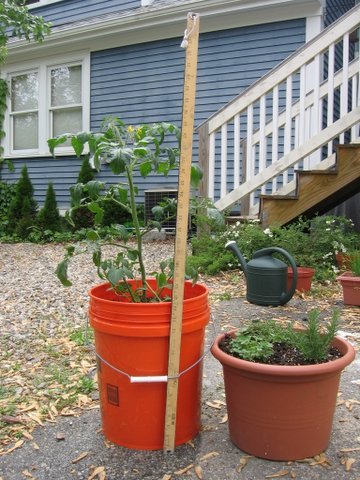
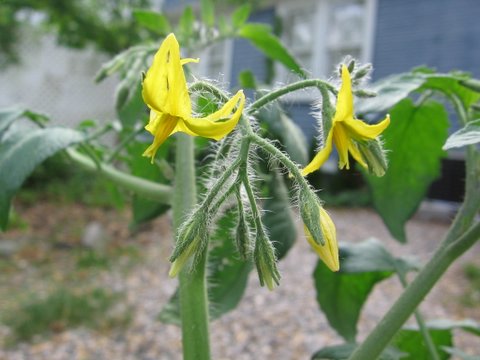 Warm weather and bright sunshine ushered in lots of new growth and even brought out a few flowers. As you'll see the plant grew quite a bit. So long as the temperatures remain below 90 during the day and below 70 at night, tomato plants will set fruit. Virginia's cooperative extension has a great page on tomato culture, which explains fruit set more. Apparently, optimal fruit set happens when nighttime temperatures are in the 60s.
 Last year we focused on vegetables but, given the uncertain future of the grange, this year we're concentrating on smaller projects, like these herbs. Planted in this container are rosemary (Rosmarinus officinalis), oregano (Origanum vulgare?), and woolly thyme (Thymus psuedolanuginosus). This type of thyme isn't edible but should fill in (and hopefully not crowd out) between the other herbs. All of the herbs are perennial, so I just might be able to keep them going until next year if they overwinter indoors. Here's a good link to a herb page maintained by NC State.
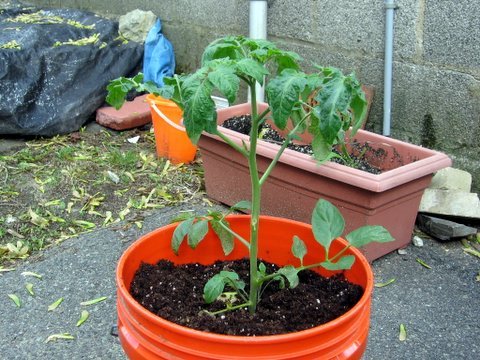 Record-setting rainfall, cold temperatures, and high winds have characterized the past three weeks on the grange. These aren't the conditions that get tomato plants growing. As a result, this plant has grown very slowly since being planted last month. After ten or eleven straight days of rain, it appeared that it would never come back.
So much for getting a jump on the season.
Conditions are to set improve later this week with temperatures forecast to hit 80F over the weekend. That should really help this guy along.
 While I don't think I've actually seen a yeti, though I may have on the red line somewhere between Park Street and Charles, I still like to believe it exists. Similarly, while I've never seen a rabbit or analagous mammal in my slice of the urban jungle, I pretend that they have a lair somewhere, perhaps deep in the sewer.
They do exist and I have proof. They must or else my neighbors have lost all maner of decorum. On Friday night something ravaged my lettuce, felling it in its prime. The damage: one plant completely uprooted, two plants mauled. Bunch of animals in this neighborhood.
Many days of rain on the grange will be followed by more even more rain and perhaps a touch of small-stream flooding for excitement. Despite the rainy weather, the lettuce is doing well, but the tomato plant has more or less stopped growing. Tomatoes apparently require warm weather. So much for my plan to get a jump on the season. With several inches of rain predicted for the weekend, the tomtato has been moved under the see-through acrylic patio table. That'll learn it.


Despite my landlord's inexorable march toward transforming my gardening space into full-time parking, the Frange defiantly welcomed its first tomato plant of the season. Oddly named a Grape Sweet Olive Tomato, this was one of the only tomato plants available at the nursery. It's way too early for tomatoes in New England, but the idea is that if the plant is brought indoors on cold nights, it will be able to get a jump on the traditional Memorial Day weekend starting time for tomatoes. Until things heat up, and evening temperatures begin to stay above the mid-40s, the plant will repair back to the warmth of my kitchen every night.
UPDATE: This plant performed quite well in a container. While not as prolific as other varieties, it was a solid producer. The fruit wasn't quite as olive shaped as expected, but they were'nt perfectly round, either. The flavor of the tomatoes was generally good but not spectacular. All in all, it tasted like a regular cherry tomato bought at a megamart. It didn't have the extra sweetness of other varieties like Super Sweet 100s.

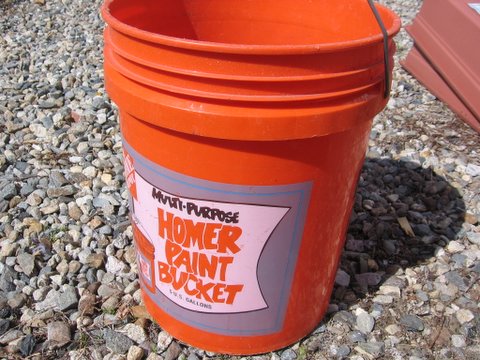 As pizza is to a pizzeria, containers are an essential part of any container garden. My favorite container is the standard five gallon utility bucket, which can be found at just about any hardware store for only a few bucks. They are incredibly durable but extremely ugly. It's a cruel tradeoff. Before using, be sure to drill a bunch of holes in the bottom, otherwise water won't be able to drain out. A drill seems like the easiest way to do this. I've heard of people heating screw drivers to punch holes.
  That's dumb. Get a drill and do your work over a sheet of newspaper so that the carved out plastic doesn't go everywhere.
 These garlic chives are very hardy. They survived the entire winter outside and then began sending up new growth in mid to late Februrary. Started from seed sometime last June, they've become quite rootbound. They are so packed in that water slips right through the container. This is a perfect time to divide this plant.
Having never done this before, I improvised and used a bit of commonsense as my guide. After wetting down the root system, I used a trowel to divide the plant into quaters. Without a doubt, I was tearing apart roots, but this is a resilient plant and it should transplant nicely.
Once the plant was divided up I rounded up several sizes of containers. It's hard to say just how deep of a container this plant needs, so it'll be interesting to see how it does in a range of sizes. Mixing together old soil from last year with some new stuff, the chives were set flush with the new soil line. Finally, I mixed up some Miracle Gro and gave them a good watering.


